- All
- Product Name
- Product Keyword
- Product Model
- Product Summary
- Product Description
- Multi Field Search


Views: 0 Author: Site Editor Publish Time: 2026-10-13 Origin: Site


Modern data centers pack massive thermal and electrical density into shrinking physical footprints. Traditional testing methods often create localized heat crises in these environments. Facility managers face a difficult engineering challenge. They must validate high-capacity power infrastructure like UPS systems, backup generators, and Coolant Distribution Units (CDUs). Doing this without overloading facility HVAC systems is difficult. Thermal runaway during commissioning poses severe risks to surrounding equipment. Yet, rigorous testing remains the only way to guarantee long-term reliability for these critical backup systems.
Enter the Liquid-Cooled Load Bank. This equipment represents a necessary evolution for high-density infrastructure testing. It provides a controlled, measurable, and facility-safe method for applying electrical loads. Instead of relying on forced air, it dissipates the resulting heat via fluid dynamics. You can safely validate power systems while keeping ambient temperatures stable. Readers will learn how these systems operate, where they fit into modern commissioning, and how to evaluate them for safe deployment.
Direct Heat Transfer Efficiency: Liquid-cooled load banks utilize the superior thermal conductivity of fluids (water, glycol mixes, or specialized coolants) to remove heat exponentially faster than air-cooled equivalents, drastically reducing the physical footprint of the testing equipment.
Critical for CDU and High-Density Validation: These systems are essential for testing in-rack Coolant Distribution Units (CDUs) and direct-to-chip cooling infrastructure prior to live IT deployment.
Risk Mitigation is Paramount: Selecting a unit requires strict evaluation of multi-layer protection systems, intelligent leak monitoring, coolant compatibility, and real-time telemetry (flow, pressure, temperature) to prevent facility damage.
Infrastructure Prerequisites: Implementation demands existing facility water loops, external chillers, or heat exchangers to manage the rejected heat, shifting the burden from HVAC to plumbing.
Table of Contents
The internal architecture relies on direct heat transfer. When electrical current passes through resistive elements, they generate intense heat. In legacy systems, massive fans force ambient air across these resistors to prevent melting. A Liquid-Cooled Load Bank abandons this method entirely. Instead, the resistive elements sit directly submerged in a dielectric fluid or rest tightly within specialized cold plates. As electrical energy converts to heat, the circulating liquid absorbs this thermal energy instantly. Fluids possess a significantly higher thermal mass than air. Water, for example, can absorb nearly 4,000 times more heat than an equal volume of air. This physical property allows the system to extract massive heat loads rapidly without raising the surrounding room temperature. The heated fluid then travels through a closed loop to an external heat exchanger or facility water loop for final rejection.
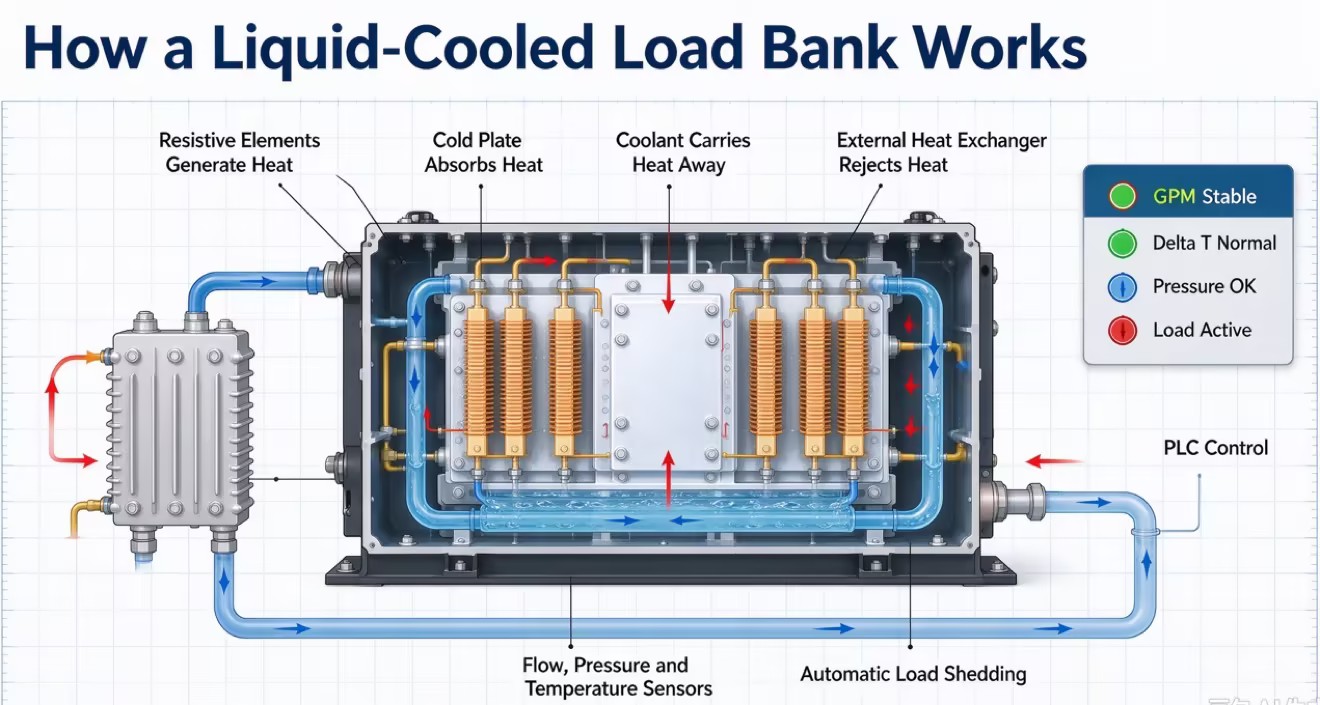
Precise test condition tracking requires constant monitoring of fluid dynamics. Operators must track several critical operational metrics to ensure the equipment functions safely under load. The system acquires this data in real time, allowing engineers to adjust parameters on the fly.
Flow meters capture the coolant flow rates in gallons per minute (GPM) or liters per minute (LPM) at the inlet.
Pressure transducers monitor the pressure differentials (Delta P) across the internal manifolds to detect blockages.
Temperature sensors track the thermal gradients (Delta T) between the supply and return lines.
Programmable Logic Controllers (PLCs) process this telemetry in milliseconds.
Automated load shedding activates if flow rates drop below a safe threshold, protecting internal elements.
Resistive load banks operate at a unity power factor (1.0 PF), making them suitable for thermal simulation and basic electrical capacity testing. Combined resistive-inductive load banks simulate lagging power factors, commonly 0.8 PF, to evaluate generator and UPS performance under reactive loads. However, specialized equipment is needed to reproduce nonlinear loads and harmonic distortion.
Air-cooled load banks release heat directly into the surrounding environment, creating challenges in high-density data centers. Excessive heat, fan noise, limited aisle space, and insufficient airflow can affect testing safety and cooling performance. These limitations become more significant as rack power density increases.
Liquid-cooled load banks transfer heat into a liquid cooling circuit, reducing heat rejection into server rooms and minimizing fan noise. They are particularly suitable for high-density rack testing, limited HVAC capacity, and direct-to-chip cooling infrastructure. Selection should consider rack power density, coolant flow, cooling capacity, and facility compatibility.
Feature | Air-Cooled Systems | Liquid-Cooled Systems |
|---|---|---|
Heat Rejection Method | Forced ambient air via high-velocity fans | Direct transfer to circulating fluids |
Physical Footprint | Large, often blocks server aisles | Compact, easily fits standard IT racks |
Noise Levels | High (often exceeds 85 dB) | Low (minimal pump noise) |
Max Rack Capacity | Typically limited to 30kW - 50kW | Scales easily from 100kW to 200kW+ |
Facility Impact | Strains HVAC, risks fire alarms | Requires existing water loops/chillers |
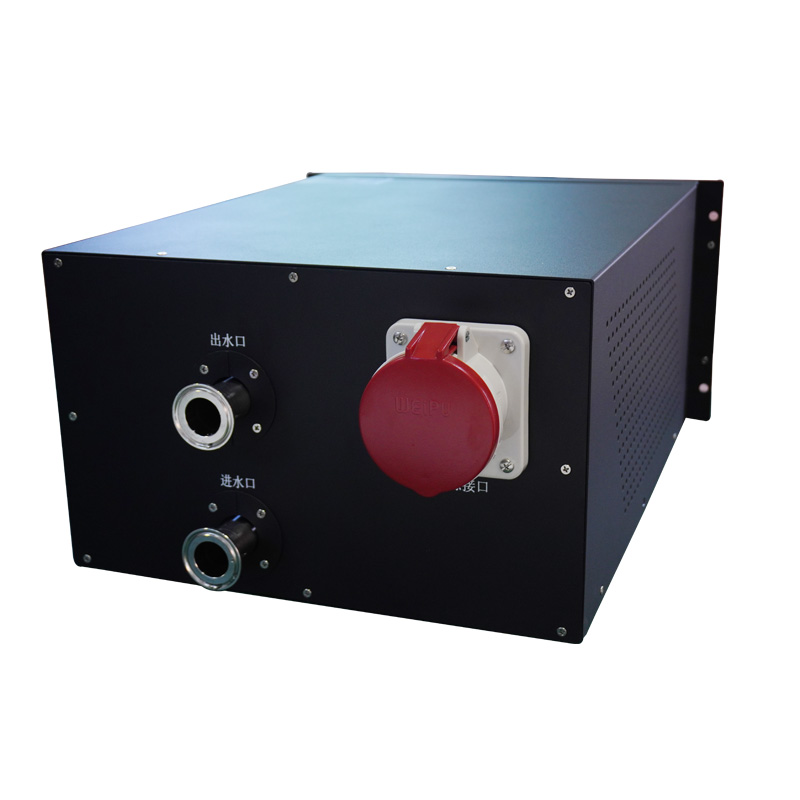
High-performance computing relies heavily on Coolant Distribution Units (CDUs). You must validate these units before installing expensive IT hardware. Rack-mounted liquid-cooled load banks serve this exact purpose. They simulate the thermal load of high-density servers. Engineers equip these units with internal cold plates. They connect directly to the CDU fluid manifolds using industrial-grade dripless quick-disconnects. Operators can then validate flow rates and pressure delivery under full load. This ensures the CDU can maintain the required Delta T across the rack. Testing uncovers flow restrictions, trapped air, or pressure drops early. It prevents catastrophic overheating when actual servers go live. During a typical commissioning sequence, technicians will step the load from 25% up to 100% capacity. They monitor the CDU's variable speed pumps to ensure they ramp up correctly in response to the increased thermal demand. If the CDU fails to deliver adequate flow at peak load, the load bank's telemetry will capture the exact moment the Delta T exceeds acceptable limits, providing actionable data for the mechanical contractors to troubleshoot the system.
Large-scale production environments require massive power validation. Facility-scale units handle capacities of 500kW and above. You cannot reject this much heat into ambient air indoors. These large systems connect to external cooling infrastructure. The heated fluid travels to an external cooling tower, dry cooler, or municipal water drain. This allows for continuous, full-load testing of massive UPS systems and backup generators. The heat leaves the building entirely. Facility managers can run multi-day endurance tests without stressing internal air conditioning systems. For example, a Tier IV data center might require a 48-hour continuous burn-in test for a new 2MW backup generator. A facility-scale Liquid-Cooled Load Bank can absorb this massive electrical load and reject the resulting 2MW of heat directly into the facility's primary chilled water loop or a temporary external cooling tower. This setup eliminates the need to park massive trailer-mounted air-cooled load banks in the parking lot and run hundreds of feet of temporary heavy-gauge cabling through open facility doors.
Hybrid load banks combine air-cooled and liquid-cooled testing in a single unit, making them suitable for data centers with mixed cooling infrastructure. They simulate electrical and thermal loads to evaluate air conditioning, direct-to-chip cooling, and liquid cooling systems simultaneously. This helps verify cooling capacity, airflow, and system performance before server deployment.
Coolant compatibility is essential for reliable liquid-cooled load bank operation. Common fluids include deionized water, propylene glycol mixtures, treated water, and engineered dielectric fluids. Buyers should verify the compatibility of stainless steel, copper, seals, and other wetted components to prevent corrosion, leakage, and equipment damage.
Leak protection systems help prevent water damage during load bank testing near sensitive electrical equipment. Essential features include containment trays, moisture sensors, pressure monitoring, automatic isolation valves, and electrical shutdown protection. These safeguards support safe commissioning and reduce the risk of cooling system failures.
Durable load bank construction ensures reliable performance during frequent transportation, installation, and testing. Rugged enclosures, leak-resistant quick-connect fittings, reinforced manifolds, and pressure-resistant components help withstand repeated connections and thermal cycling, reducing maintenance requirements and extending equipment service life.
Data monitoring and system integration are essential for accurate load bank testing and commissioning. Modern units record electrical parameters, coolant flow, and temperature data to verify cooling performance. Compatibility with DCIM, BMS, Modbus TCP/IP, or SNMP enables centralized monitoring, data analysis, and efficient commissioning documentation.
A liquid-cooled load bank is a specialized tool for high-density environments. Liquid-to-liquid and CDU testing demand this technology where ambient heat rejection is impossible. It allows facilities to validate power infrastructure safely and accurately. Decision-makers should begin their procurement process by auditing their facility's existing cooling infrastructure. You must confirm chilled water availability before specifying a unit. Ensure the equipment's telemetry capabilities match your commissioning documentation requirements.
Audit your facility's existing water loops to confirm available flow rates and heat rejection capacity.
Consult with a thermal engineer to verify material compatibility between your facility fluids and the equipment's wetted parts.
Request specific flow and pressure drop curves from manufacturers to ensure alignment with your CDU specifications.
Schedule a site audit to determine the plumbing feasibility and routing for supply and return lines.
A: They are functionally synonymous in application. However, "liquid-cooled" is a broader term. It encompasses dielectric fluids, glycol mixtures, and engineered low-concentration coolants. "Water-cooled" specifically implies the use of treated facility water or deionized water as the primary heat transfer medium.
A: Yes. While most standard liquid-cooled units are purely resistive for thermal simulation and capacity testing, custom units exist. Engineers can incorporate inductive elements into the design. This allows for full power factor testing, which is necessary for comprehensive generator and UPS validation.
A: Safe coolants depend entirely on the CDU manufacturer's specifications. Common fluids include PG25 (propylene glycol mix), deionized water, or specific low-concentration coolants. You must match the fluid to the wetted materials to prevent galvanic corrosion and internal scaling.
A: They utilize multi-layer protection. Physical moisture tape and sensors detect liquid accumulation in the base tray. Simultaneously, software monitors the fluid loop for sudden pressure drops. If a leak is detected, the system triggers automatic shut-off valves and drops the electrical load instantly.
A: In-rack units typically range from 20kW to 100kW to simulate high-density servers. However, facility-scale units can handle 500kW or more. By networking multiple units together in parallel, operators can scale the testing capacity to multiple megawatts.
A: Modern data centers often utilize transitional cooling strategies. They deploy both rear-door heat exchangers (or direct-to-chip cooling) and traditional CRAC units. A hybrid load bank allows operators to apply electrical load and validate both the air and liquid cooling systems simultaneously.


