- All
- Product Name
- Product Keyword
- Product Model
- Product Summary
- Product Description
- Multi Field Search


Views: 0 Author: Site Editor Publish Time: 2026-09-29 Origin: Site


Data center rack densities routinely exceed 50kW to 100kW to support advanced computational workloads, artificial intelligence training clusters, and high-frequency trading platforms. This shift forces infrastructure engineers toward direct-to-chip and immersion cooling technologies, rendering legacy heat rejection methods obsolete. Accurately commissioning modern infrastructure presents a significant challenge for facility operators. Traditional testing methods fail to replicate the exact thermal and electrical behavior of high-density, liquid-cooled IT deployments. Relying on outdated testing methodologies leaves cooling flaws undetected until live production equipment is installed, risking catastrophic downtime. Facility managers and commissioning agents face an engineering decision before bringing a new data hall online. They must determine whether traditional air-cooled load banks remain sufficient for their specific architecture. Alternatively, the facility's mechanical design might necessitate liquid-cooled load banks to validate power and cooling systems effectively. Exploring a liquid cooled vs air cooled load bank comparison ensures reliable facility operation. Understanding the technical nuances between these systems allows engineering teams to align their testing methodology directly with the facility's mechanical topology.
Density and Footprint: Liquid-cooled load banks offer significantly higher kW density per square foot, making them essential for testing space-constrained, high-density data halls.
Infrastructure Prerequisites: The viability of liquid-cooled load banks depends entirely on the facility's existing mechanical topology (e.g., availability of chilled water loops, CDUs, or facility water supply).
Simulation Accuracy: Air-cooled units test the Computer Room Air Conditioning (CRAC/CRAH) systems, while liquid-cooled units directly test the facility's fluid cooling loops, matching the actual deployment of liquid-cooled servers.
Acoustics and Safety: Liquid-cooled systems operate at significantly lower decibel levels, eliminating the severe noise hazards associated with the high-velocity fans of air-cooled units.
Cost Dynamics: Air-cooled systems present lower CapEx and easier deployment, whereas liquid-cooled systems require higher initial investment and complex plumbing but offer lower operational disruption and superior thermal accuracy during testing.
Table of Contents
Modern data centers are shifting from traditional air cooling toward liquid cooling to support higher-density computing. Testing with air-cooled load banks may not accurately verify liquid cooling infrastructure because it fails to simulate real fluid flow, pressure changes, and heat transfer conditions. For liquid-cooled facilities, load banks must replicate the actual server cooling method to properly validate coolant distribution units and thermal performance.
Successful Level 4 and Level 5 commissioning requires accurate simulation of operational conditions. Component testing verifies individual equipment performance, while Integrated Systems Testing confirms that the complete electrical and mechanical systems operate correctly under full load. Testing criteria should include electrical stability, heat rejection capability, and system resilience under maximum operating conditions.
Modern load testing evaluates more than electrical power consumption. Engineers must verify cooling loop performance, Delta-T control, and system response to rapid load changes. Selecting an unsuitable load bank can hide problems such as insufficient flow rates, incorrect valve operation, or undersized heat exchangers, creating potential failures after the data center becomes operational.
Air-cooled load banks have served as the backbone of data center commissioning for decades. These units operate through a straightforward mechanical process. Resistive elements convert electrical power into heat. High-velocity fans then force ambient air across these hot elements, dissipating the thermal energy directly into the data hall. The facility's Computer Room Air Conditioning units or air handlers must then capture this hot exhaust and reject it from the building. This method perfectly simulates traditional air-cooled server racks.
Air-cooled load banks provide simple deployment and high flexibility during commissioning. They are easy to move, quickly reconfigured, and can be combined to achieve different test loads. Since they require no liquid connections, they eliminate plumbing risks and only need temporary electrical connections, making installation faster and easier.
Air-cooled systems have limitations when testing modern high-density facilities. Large thermal loads require significant airflow, which can exceed the capacity of cooling systems and cause hot-air recirculation or overheating. They also require more physical space, making them inefficient for simulating high-density racks. In addition, multiple high-speed fans create excessive noise, affecting communication and requiring additional safety measures during commissioning.
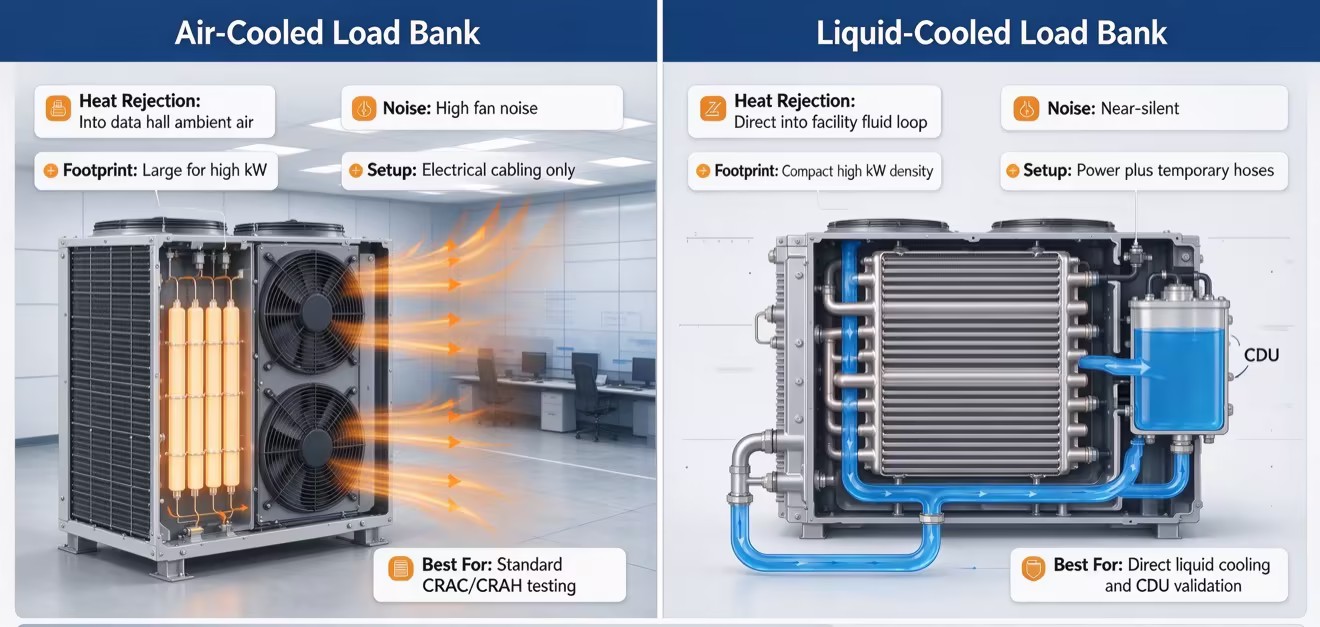
As rack densities push past the capabilities of ambient air, engineering teams pivot to specialized equipment. liquid-Cooled Load Banks represent the necessary evolution in facility testing. These units utilize internal heat exchangers to transfer electrical heat directly into a circulating fluid loop. By completely bypassing the ambient air, they inject thermal energy straight into the facility's primary or secondary cooling infrastructure. This direct transfer mechanism is the only way to accurately validate modern high-performance computing environments.
Liquid-cooled load banks provide highly accurate testing by replicating real cooling systems such as direct liquid cooling, rear-door heat exchangers, and immersion cooling. They allow engineers to verify flow rates, pressure losses, and heat transfer performance under realistic operating conditions. Their high power density enables large thermal loads to be tested within compact rack spaces, while low heat rejection and quiet operation improve the commissioning environment.
Liquid-cooled testing equipment requires a fully operational cooling infrastructure before deployment. Coolant Distribution Units, fluid loops, and manifolds must be flushed, filled, and pressurized before connection. Engineers must verify hydraulic compatibility, calculate flow and pressure requirements, and ensure temporary hoses do not affect system performance. Material compatibility checks are also necessary to prevent corrosion between the load bank and facility cooling fluids.
Selecting the appropriate testing methodology requires a comprehensive engineering analysis. Facility operators must evaluate several core dimensions to ensure the commissioning process yields valid, actionable data. The decision impacts not only the accuracy of the test but also the logistical complexity of the entire project.
The interaction between the testing equipment and the facility's mechanical plant dictates the validity of the commissioning report. Air-cooled units test the chillers indirectly via the air handlers. The heat must transfer from the load bank to the air, and then from the air to the chilled water coils. This multi-step process introduces thermal lag and masks the precise performance of the fluid loops. Liquid-cooled units test the chillers via direct fluid heat exchange. This allows engineers to monitor precise Delta-T control across the heat exchangers, providing a highly accurate profile of the system's cooling capacity.
Staging logistics heavily influence the choice of testing equipment. Analyzing the floor space required for a 1MW test reveals stark differences. Achieving 1MW of heat rejection with air-cooled units requires staging numerous bulky machines, occupying significant square footage and complicating the routing of temporary power cables. Conversely, 1MW of liquid-cooled load banks can be condensed into a fraction of that space. This compact footprint is vital when testing modular data centers or high-density edge facilities where physical space is severely limited.
Setup complexity varies drastically between the two methodologies. Air-cooled testing relies primarily on heavy temporary electrical cabling. The main logistical challenge involves routing these cables safely from the temporary switchgear to the load banks without obstructing emergency egress routes. Liquid-cooled testing introduces a dual dependency. It requires both temporary electrical cabling and temporary piping or hose management. Engineers must calculate associated pressure drops, manage fluid volumes, and ensure all temporary connections are rated for the system's operating temperature and pressure.
Prolonged commissioning phases consume massive amounts of energy and water. Testing methodologies directly impact the facility's Power Usage Effectiveness and Water Usage Effectiveness metrics during this period. Liquid-cooled testing is generally more energy-efficient, as it eliminates the electrical draw of dozens of high-velocity load bank fans. Furthermore, by transferring heat directly to the fluid loops, the facility's mechanical plant can operate at its designed efficiency curve, providing a more accurate representation of the site's long-term environmental impact.
Evaluation Criteria | Air-Cooled Load Banks | Liquid-Cooled Load Banks |
|---|---|---|
Simulation Target | CRAC/CRAH units and ambient air flow | CDUs, fluid loops, and direct heat exchange |
Physical Footprint | Large (requires multiple units for high kW) | Compact (high kW density per square foot) |
Acoustic Profile | Extremely loud (often requires strict PPE) | Near-silent operation |
Setup Complexity | Electrical cabling only | Electrical cabling plus fluid hose management |
Heat Rejection | Into the data hall ambient air | Directly into the facility fluid loop |
Executing a Level 5 Integrated Systems Test involves significant operational risk. Pushing a newly constructed facility to its maximum design limits requires strict safety protocols. Engineering teams must anticipate potential failures in the temporary testing setup and implement robust mitigation strategies to prevent damage to the permanent infrastructure.
Temporary liquid systems in data halls create potential leak hazards. Engineers must perform pressure testing before operation, typically using hydrostatic tests above normal operating pressure. Drip trays, moisture sensors, and safer fluids help reduce the impact of leaks and protect electrical equipment.
Air-cooled load banks require proper airflow control to avoid hot air recirculation. Temporary containment, blanking panels, and airflow calculations help separate hot and cold air streams. Maintaining proper airflow rates and temperature differences prevents hot spots and inaccurate test results.
Integrated Systems Testing requires continuous operation, often for 24–48 hours at full load. A load bank failure can interrupt testing and delay commissioning. Using N+1 load bank configurations with backup units allows engineers to maintain test continuity during equipment failures.
Successful load bank testing depends on precise equipment delivery and coordination with construction schedules. A reliable vendor should provide technical documentation, flexible logistics support, and installation planning. Proper staging, testing, and gradual load increases ensure smooth commissioning.
Key field procedures:
Inspect electrical connections with thermal imaging before applying full load.
Perform pressure tests on temporary fluid systems to confirm leak-free operation.
Install drip protection and moisture monitoring at connection points.
Record baseline temperature and airflow conditions before testing.
Increase load gradually in stages while monitoring system performance.
Determining the correct testing methodology is not a matter of simply choosing the newest technology. The decision must be rooted in the specific mechanical design of the facility. Commissioning agents must evaluate the incoming IT equipment's thermal profile and select the load bank that most accurately simulates that specific heat rejection method.
Air-cooled units remain the optimal choice for specific facility profiles. They are the standard for legacy data halls designed strictly for ambient air cooling. Facilities deploying lower density racks, typically under 20kW per cabinet, can be accurately tested using traditional methods. Furthermore, if a facility completely lacks liquid cooling infrastructure, such as chilled water loops or in-row CDUs, air-cooled testing is the only viable option. They provide a straightforward, effective method for validating standard CRAC and CRAH deployments without overcomplicating the setup process.
Certain modern deployments absolutely mandate the use of liquid-cooled testing equipment. High-performance computing clusters, dedicated AI data centers, and facilities utilizing direct-to-chip cooling cannot be accurately commissioned with ambient air. When the facility's air handlers are physically incapable of processing the total IT load, attempting an air-cooled test will result in immediate thermal runaway. In these environments, liquid-cooled units are required to validate the primary heat rejection pathways, ensure the CDUs operate correctly, and verify the integrity of the facility's fluid manifolds.
Many modern data centers operate as mixed-density environments. These facilities feature zones of standard air-cooled racks alongside specialized pods of high-density, liquid-cooled equipment. Commissioning these hybrid halls requires a blended testing approach. Agents must deploy a combination of both technologies simultaneously. Air-cooled load banks are staged in the standard containment aisles to stress the CRAC units, while liquid-cooled load banks are connected to the CDUs in the high-density pods. This hybrid methodology accurately simulates the complex thermal dynamics of a facility that utilizes multiple cooling architectures concurrently.
Consult with MEP engineers during the initial schematic design phase to specify exact testing requirements and load bank methodologies.
Request detailed technical submittals and hydraulic calculations from load bank vendors to verify compatibility with facility flow rates.
Develop a comprehensive staging and logistics plan that accounts for temporary power routing, hose management, and N+1 redundancy during the IST.
Implement strict leak mitigation protocols, including hydrostatic pressure testing and moisture sensor deployment, before energizing any fluid-based testing equipment.
A: Using air-cooled units in a liquid-cooled facility only tests the secondary air handlers. It fails to validate the primary fluid loops, Coolant Distribution Units, and direct heat exchange mechanisms. This creates false positives in the commissioning report, leaving the primary cooling infrastructure unverified under full load.
A: The facility must have operational primary or secondary fluid loops, functional Coolant Distribution Units (CDUs), and appropriate connection manifolds. The system must be fully flushed, pressurized, and capable of providing the specific flow rates required by the load bank's internal heat exchangers.
A: Liquid-cooled units offer significantly higher power density, allowing them to simulate massive kW loads within a much smaller physical footprint. Simulating high-density loads with air-cooled units requires staging multiple bulky machines, which often exceeds the available floor space in modern containment aisles.
A: Air-cooled units generate extreme noise levels due to high-velocity fans, often exceeding OSHA safety limits and requiring strict PPE protocols. Liquid-cooled units operate near-silently because they reject heat directly into a fluid loop, creating a safer and more communicative working environment.
A: While capacities vary by manufacturer, single portable air-cooled units typically range from 100kW to 300kW. Simulating higher density loads requires daisy-chaining multiple units together, which significantly increases the required floor space and temporary cabling complexity.
A: Yes, introducing temporary plumbing carries inherent leak risks. This is mitigated by performing strict hydrostatic pressure tests on all temporary hoses, utilizing extensive drip trays with moisture sensors, and occasionally using dielectric fluids to prevent electrical damage in the event of a minor leak.


