- All
- Product Name
- Product Keyword
- Product Model
- Product Summary
- Product Description
- Multi Field Search


Views: 0 Author: Site Editor Publish Time: 2026-10-13 Origin: Site


A data center outage costs millions in lost revenue and damages corporate reputations permanently. Passing idle or low-load tests never guarantees infrastructure resilience under peak IT demand. Commissioning agents (CxA) and facility managers must accurately simulate both electrical and thermal loads to validate UPS systems, backup generators, and HVAC/CRAH units before deploying live IT equipment. A structured evaluation process for choosing a Data Center load bank is essential. You must focus on load types, form factors, thermal dynamics, and data logging capabilities to ensure Uptime Institute or ASHRAE compliance. We will break down the exact specifications required to stress-test your facility infrastructure properly and expose hidden vulnerabilities before you go live.
Match Load Type to Infrastructure: Resistive load banks test raw power and heat, while reactive/RLC load banks are mandatory for testing the true power factor of UPS systems and generators.
AC vs. DC Testing Requirements: While AC load banks handle facility-level power, DC load banks are essential for validating battery strings and UPS DC buses.
Form Factor Dictates Accuracy: Rack-mounted load banks provide granular, server-level thermal simulation (Delta-T), whereas large trailer-mounted units are best for bulk generator testing.
Data is the Deliverable: Modern commissioning requires load banks with high-resolution telemetry and BMS (Building Management System) integration to prove transient response and system stability.
Rent vs. Buy Depends on Lifecycle: Purchasing makes sense for ongoing maintenance and multi-phase builds, while renting is often more capital-efficient for one-off Level 4/5 Integrated Systems Testing (IST).
Table of Contents
Factory acceptance tests (FAT) happen in highly controlled manufacturing environments. They verify basic equipment functionality under perfect conditions. However, on-site commissioning introduces unpredictable real-world variables. Ambient temperatures fluctuate. Voltage drops occur across long facility cable runs. Breaker coordination schemes often look perfect on paper but fail during actual load transfers. Load banks force backup generators, UPS systems, and PDUs to operate at 100% design capacity. This intense stress exposes weak breakers, reveals faulty wiring connections, and highlights cooling dead zones inside the white space.
Level 4 component testing isolates individual units for performance verification. You test a single UPS module or a specific CRAH unit to ensure it meets the manufacturer's nameplate rating. Level 5 Integrated Systems Testing (IST) evaluates the entire facility simultaneously. You pull the main utility breaker. The generators must start automatically. The UPS must carry the critical load without interruption. The cooling system must restart seamlessly. Load banks simulate the IT equipment during this critical transition, providing the exact electrical and thermal footprint of a fully populated data hall.
Post-commissioning, routine testing prevents "wet stacking" in diesel backup generators. Running diesels at low loads prevents the engine from reaching optimal combustion temperatures. Unburned fuel and soot accumulate in the exhaust stack. This carbon buildup degrades engine performance rapidly and creates a severe fire hazard. Applying a full load burns off these deposits, restores engine efficiency, and ensures emergency readiness when the grid fails.
Uptime Institute Tier Certification demands strict fault tolerance. Testing proves concurrent maintainability during simulated component failures. You must prove the facility can sustain full operations while isolating specific electrical or cooling paths. If you claim a Tier III or Tier IV rating, the commissioning agent will demand physical proof that redundant systems take over seamlessly under full load.
ASHRAE TC 9.9 guidelines govern thermal management in IT environments. Load banks simulate server exhaust heat accurately. This verifies hot and cold aisle containment effectiveness. It proves the cooling infrastructure can maintain required inlet temperatures under maximum thermal stress. Without accurate thermal simulation, you risk deploying servers into an environment that cannot reject the heat they produce, leading to thermal runaway and hardware failure.
AC units handle massive facility-level power. You connect them to main switchgear or large distribution panels. They test backup generators and UPS AC outputs. They validate overall facility power distribution networks. These units operate at standard facility voltages, typically 480V or 415V 3-phase, and draw massive amounts of current to simulate the entire building's load.
Conversely, a Data Center load bank designed for direct current executes highly specialized tasks. Facilities rely on DC units for critical battery discharge testing. They validate telecom rectifiers and test the DC link of UPS systems. This ensures reliable battery ride-through during utility failures. VRLA and modern lithium-ion battery strings require precise, controlled discharge profiling to verify their actual runtime capacity against manufacturer specifications. You cannot use an AC unit for this task; DC contactors and resistive elements must be specifically engineered to extinguish DC arcs safely.
Load bank selection depends on the electrical characteristics being tested. Resistive load banks simulate active power (kW), while reactive units simulate inductive or capacitive power (kVAR). RLC load banks combine these capabilities to evaluate generators and UPS systems under different power factor conditions, providing more comprehensive electrical performance testing.
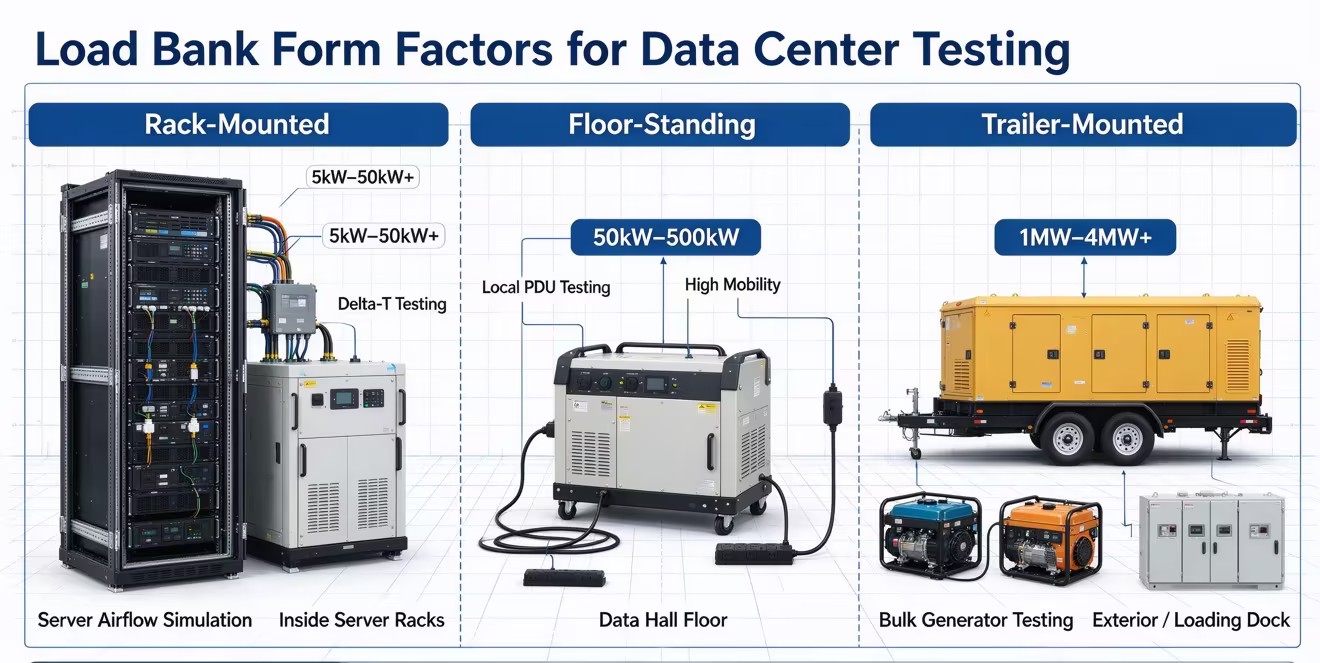
Load bank configurations vary according to testing capacity, installation space, and application requirements. Rack-mounted units simulate server loads and airflow, floor-standing units provide flexible testing of electrical distribution equipment, and trailer-mounted systems support large-scale generator and infrastructure commissioning.
Load Bank Type | Main Advantage | Best Application |
|---|---|---|
Rack-Mounted | Accurate rack-level power and airflow simulation | Data center server racks |
Floor-Standing | Portable and flexible installation | PDUs and electrical distribution testing |
Trailer-Mounted | High-capacity, multi-megawatt testing | Generators and main power infrastructure |
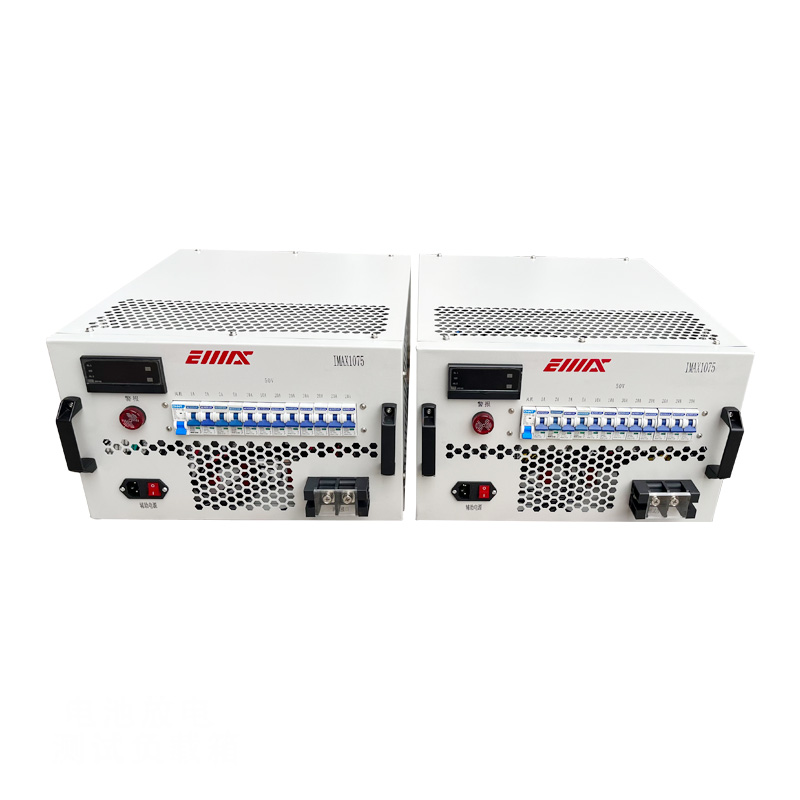
Load bank capacity planning should match the facility's design load and future expansion requirements. Modular load banks allow flexible testing across multiple data halls, while high-density rack-mounted units can simulate 50–100 kW per rack where supported. Proper sizing helps verify electrical and cooling infrastructure under realistic operating conditions.
Step-loading tests evaluate how generators, UPS systems, and power distribution equipment respond to changing electrical demand. Load banks typically apply controlled increments of 25%, 50%, 75%, and 100%, while monitoring voltage, frequency, and recovery time. Overload testing should only be performed within approved equipment ratings and testing procedures.
Thermal load simulation verifies whether data center cooling systems can manage expected IT heat output. Rack-mounted load banks should replicate appropriate airflow rates, exhaust temperatures, and Delta-T between hot and cold aisles. Proper airflow control and containment help identify cooling limitations and prevent localized overheating.
Modern load banks provide real-time monitoring of voltage, current, frequency, power, and thermal performance. Automated data logging supports commissioning reports and performance verification. Integration with Building Management Systems (BMS) through compatible protocols, such as Modbus TCP/IP or SNMP, enables centralized monitoring and analysis.
Renting load banks reduces upfront investment, storage requirements, and maintenance responsibilities, making it suitable for occasional commissioning projects. Purchasing load banks may provide better long-term value for facilities conducting frequent testing or continuous expansion. The decision depends on testing frequency, equipment utilization, and total ownership costs.
Load bank deployment costs include transportation, temporary electrical cabling, installation labor, and site preparation. Large trailer-mounted units require suitable access and cable routing, while rack-mounted units involve individual installation and power connections. Proper logistics planning helps control project costs, reduce setup time, and maintain testing safety.
Logistical Factor | Rack-Mounted Fleet (100 units) | Trailer-Mounted Unit (2MW) |
|---|---|---|
Setup Time | High (Individual rack installation) | Low (Park and pull main cables) |
Cable Requirements | Standard C13/C19 power cords | Heavy 4/0 AWG temporary cables with cam-locks |
Floor Weight Impact | Distributed evenly across racks | None (Remains outside the white space) |
Thermal Impact | Accurate white space heating | Heat rejected outside the building |
Temporary high-voltage cabling can create voltage drops, connection failures, and safety hazards during data center load bank testing. Proper cable sizing, secure cam-lock connections, and suitable cable protection help maintain electrical stability. Using existing power distribution infrastructure where appropriate can reduce installation complexity and improve testing accuracy.
Improper load bank placement can cause localized overheating, airflow disruption, and false HVAC or fire alarm activation. Rack-mounted load banks, blanking panels, and carefully planned exhaust paths help simulate realistic server cooling conditions. Proper airflow management ensures accurate thermal testing without unnecessarily stressing facility cooling systems.
Load bank safety systems should include over-temperature protection, airflow monitoring, emergency stop controls, and automatic load shedding. These features help prevent overheating and equipment damage during high-power testing. Appropriate arc-flash protection, safety briefings, and coordinated communication further reduce operational risks during Integrated Systems Testing (IST).
The right testing equipment bridges the gap between theoretical design and operational reality. You must define the test level, calculate the required capacity, select the appropriate form factor, and choose a procurement model that aligns with your operational lifecycle. Follow these actionable steps to ensure a successful commissioning process:
Consult your Commissioning Agent to define the exact IST script parameters, load step requirements, and transient response thresholds.
Calculate temporary cable voltage drops and map out physical deployment paths to avoid logistical bottlenecks on the data hall floor.
Verify BMS integration capabilities for automated data logging, ensuring you capture high-resolution metrics for final certification.
Schedule a site walk with your equipment provider to finalize capacity sizing, thermal exhaust routing, and safety boundaries.
Establish clear safety protocols, arc flash boundaries, and emergency load shedding procedures before initiating any high-voltage tests.
A: Resistive testing simulates pure active power (kW) and generates heat at a 1.0 power factor. Reactive testing simulates inductive or capacitive loads (kVAR). Combining them tests the true power factor of UPS systems and generators under realistic conditions, ensuring the infrastructure handles the complex impedance of modern servers.
A: A DC unit validates battery strings, telecom rectifiers, and the DC link of UPS systems. It performs controlled battery discharge tests to ensure reliable ride-through capabilities during utility power failures. It safely dissipates direct current energy without the arcing risks associated with using AC equipment.
A: The exact number depends on your facility's design IT load and rack density. You must match the total kW capacity and distribute the units to simulate the intended thermal footprint across hot and cold aisles. For example, a 1MW data hall designed for 10kW racks requires 100 individual 10kW units.
A: Level 5 commissioning, or Integrated Systems Testing (IST), evaluates the entire facility as a unified system. It simulates full operational loads and utility failures to verify that generators, UPS units, and cooling systems work together seamlessly under maximum stress.
A: Diesel generators running at low loads accumulate unburned fuel and carbon in the exhaust system. Applying a full load burns off these deposits, maintaining engine efficiency, preventing exhaust fires, and preventing long-term mechanical degradation of the fuel injectors.
A: Rack-mounted units mimic the exact power draw and heat exhaust of actual servers. Variable fan speed controls adjust the airflow (CFM) to match the specific Delta-T expectations, validating the performance of CRAH units and hot/cold aisle containment structures.


