- All
- Product Name
- Product Keyword
- Product Model
- Product Summary
- Product Description
- Multi Field Search


Views: 0 Author: Site Editor Publish Time: 2026-09-29 Origin: Site


Data center outages carry severe financial and reputational consequences. Untested power and cooling infrastructure is a primary culprit behind these catastrophic failures. Facility managers often rely on component-level testing during early commissioning phases. However, a massive gap exists between isolated equipment checks and real-world operational readiness. Deploying live IT equipment without validating the facility's response to peak and transient loads introduces unacceptable risk. You cannot afford to discover a cooling bottleneck or a generator synchronization failure after servers go live.
To bridge this gap, engineers execute data center load bank testing. This process serves as the definitive method for Integrated Systems Testing (IST), also known as Level 5 Commissioning. It allows operators to safely simulate complex IT loads across the entire facility. By deploying synthetic heat and electrical draw, you validate redundancy, stress-test backup systems, and prove overall system resilience. This ensures the infrastructure handles everyday operations and sudden emergency failovers before a single production server arrives.
Comprehensive Validation: Load banks are mandatory for Level 5 Integrated Systems Testing (IST), simultaneously stressing electrical, HVAC, and backup systems under controlled, synthetic loads.
Configuration Dictates Accuracy: The choice between rack-mounted, floor-standing, resistive, and reactive load banks directly impacts the validity of the test, particularly for airflow and cooling loop assessments.
Lifecycle Reliability: Beyond initial commissioning, routine load bank testing is essential to verify and maintain power systems throughout the facility's operational lifespan.
Risk Mitigation: Rigorous testing identifies single points of failure, transient response flaws, and thermal containment breaches before live server deployment.
Strategic Sourcing: Deciding between renting and purchasing a data center load bank depends on testing frequency, facility scale, and long-term maintenance capabilities.
Table of Contents
Level 5 Integrated Systems Testing verifies that the entire facility can operate reliably under full design load and failure conditions. Testing must confirm system performance during utility outages, redundancy failovers, and maintenance scenarios while maintaining stable power and cooling conditions.
Synthetic load testing provides a safe and controlled way to simulate real IT power and heat demands. Unlike live servers, load banks allow engineers to apply precise, repeatable loads without risking operational equipment. This enables full-load testing of electrical and cooling systems before the facility becomes operational.
Load testing should continue throughout the facility lifecycle. Regular testing helps identify aging equipment issues such as generator degradation, UPS battery capacity loss, and cooling system performance decline. Routine synthetic load tests support preventive maintenance, verify reliability, and provide documented proof of ongoing operational readiness.
Electrical validation forms the backbone of facility commissioning. You must stress every component in the power chain from the utility substation down to the rack-level distribution.
UPS systems require full-load testing to verify battery runtime, discharge performance, and seamless power transfer. Synthetic loads confirm that bypass systems and inverter transitions operate correctly without interrupting critical power.
Load testing ensures diesel generators operate efficiently and prevents issues such as wet stacking caused by insufficient loading. Synthetic loads also verify Automatic Transfer Switch performance, generator synchronization, and the ability to handle sudden power demand changes.
High-density computing environments require validation of busways, PDUs, and high-current electrical systems under maximum load. Synthetic testing combined with thermal inspection helps identify overheating risks, voltage drops, and weak electrical connections.
Cooling systems must be tested to ensure they can remove the heat generated by IT equipment. Synthetic loads simulate real thermal conditions and verify the performance of chillers, cooling towers, CRAC units, pumps, and fans.
Synthetic loads generate realistic heat output to test the complete cooling plant. Engineers evaluate cooling capacity, temperature stability, and equipment response during changing thermal conditions.
Full-load testing verifies airflow balance and containment effectiveness. Engineers identify bypass airflow, hot spots, and pressure issues while optimizing fan speeds and airflow distribution to maintain proper rack temperatures.
Modern facilities increasingly rely on complex energy mixes, including solar, wind, and local microgrids.
Integrating renewable energy sources introduces power quality challenges. Synthetic loads simulate electrical demands to test the stability and load-sharing capabilities of microgrids. You must validate the transient response when solar arrays suddenly drop output due to cloud cover. Testing ensures that battery energy storage systems (BESS) or traditional generators instantly pick up the slack, maintaining a stable frequency and voltage for the critical IT load. Islanding tests prove the facility can disconnect from the main utility grid and operate autonomously on its microgrid without dropping the critical load.
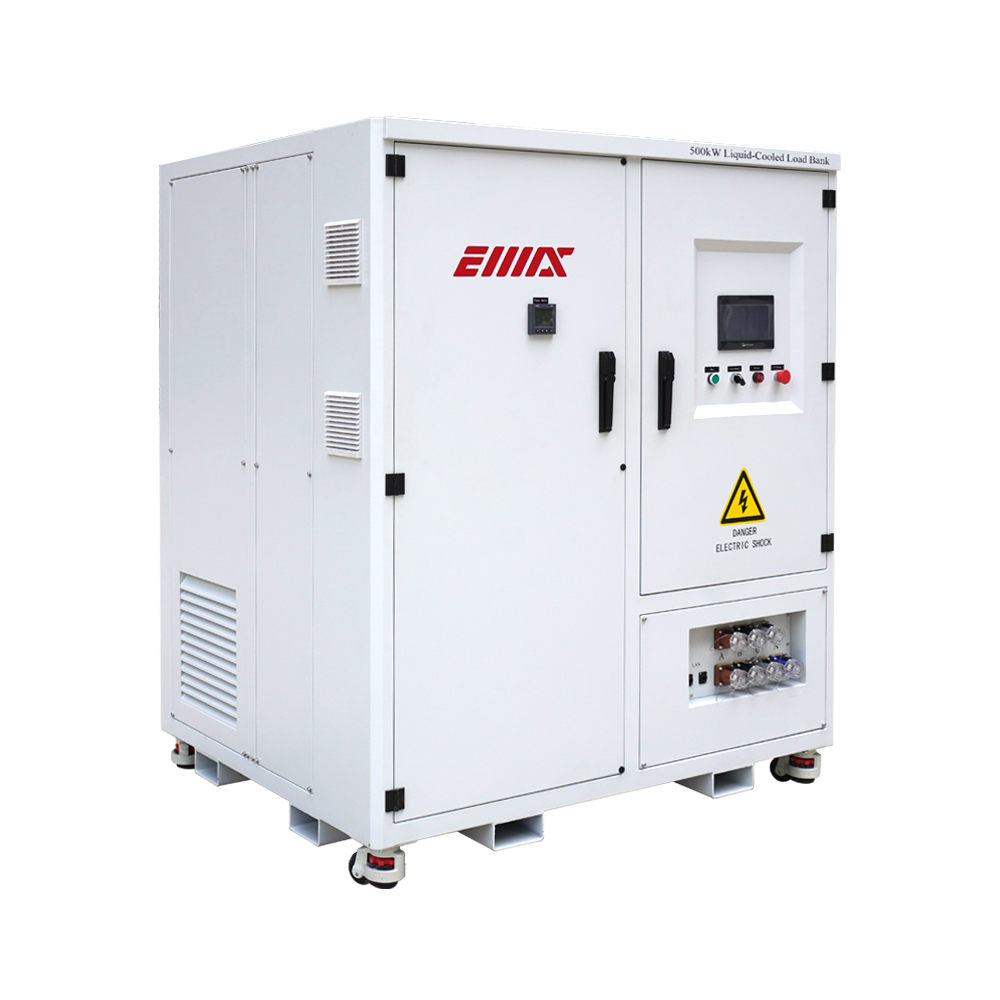
Selecting the correct electrical profile is crucial for accurate simulation. You must match the test equipment to the anticipated load characteristics of the facility.
Resistive units simulate pure active power. They test the system at a 1.0 power factor, converting electrical energy entirely into heat. This is ideal for testing cooling systems, UPS battery runtimes, and basic generator capacity. Reactive units introduce inductors or capacitors. They test apparent power (kVA), typically at a 0.8 lagging power factor. This simulates the complex electrical draw of motor loads, transformers, and older server power supplies.
Use resistive units when your primary goal is thermal validation or testing modern, power-factor-corrected IT equipment. Choose reactive units when commissioning large UPS systems or testing the alternator capacity of backup generators. Many comprehensive IST protocols require a combination of both to fully stress the electrical infrastructure. A combined resistive/reactive unit allows engineers to adjust the power factor dynamically during the test.
Physical placement dictates the accuracy of airflow and thermal testing. Deploying the wrong form factor invalidates cooling performance data.
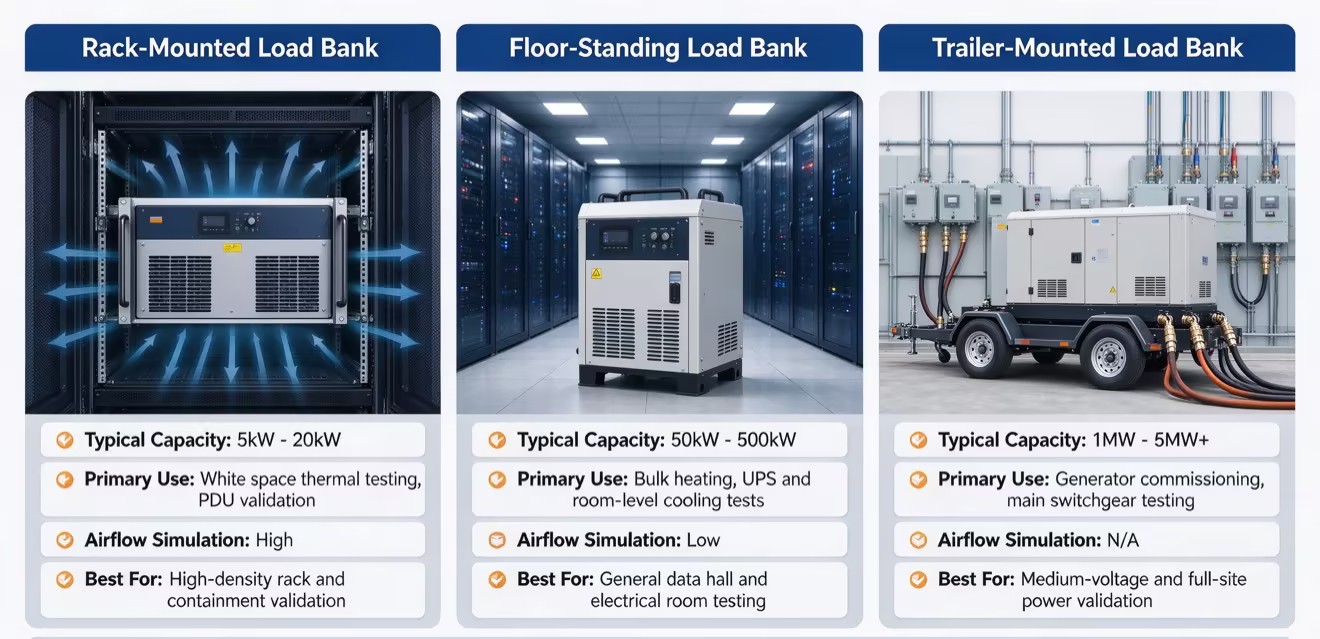
These 19-inch units install directly into server cabinets. They provide highly accurate, localized heat and airflow simulation. Rack units mimic the exact exhaust patterns of IT equipment. They are essential for validating hot/cold aisle containment, rack-level PDUs, and precise Delta-T measurements across the white space. If you are testing a high-density 40kW rack design, you must use rack-mounted units to prove the containment system can handle the localized thermal density.
Mid-sized, portable units offer bulk load testing. They are typically deployed in data halls or electrical rooms. While they generate significant heat and electrical draw, they do not accurately simulate rack-level airflow. They are best used for stressing bulk power distribution, UPS systems, and overall room-level cooling capacity. Engineers often use these units to apply a baseline thermal load to the room before fine-tuning with rack-mounted units.
Multi-megawatt external units are deployed outside the facility. They connect directly to primary switchgear or generators. These massive units are used for initial generator commissioning, medium-voltage testing, and validating the utility substation before internal facility wiring is complete. They utilize heavy-duty camlok cables to handle thousands of amps safely.
Accurate sizing prevents under-testing and equipment damage. You must calculate the total required capacity based on the facility's maximum design kW or kVA.
Do not rely on a single, massive unit for the white space. Instead, use multiple networked units to step-load the facility. This modular approach allows you to distribute the heat evenly across the data hall, accurately reflecting a fully populated server environment. Networked units can be controlled from a single interface, allowing precise, synchronized load steps. When sizing, always account for the N+1 or 2N redundancy design. You must have enough synthetic load to push the primary systems to 100% while verifying the redundant systems remain in standby.
Applying the load correctly is just as important as the load itself. Dumping 100% capacity onto a cold system is dangerous and provides poor diagnostic data.
Engineers must incrementally apply load to monitor system stability. This incremental approach safely identifies weak points before a catastrophic failure occurs. A standard field procedure follows a strict sequence:
Apply 25% load and hold for 30 minutes. Verify initial voltage stability and cooling system activation.
Increase to 50% load and hold for 1 hour. Monitor UPS battery temperatures and generator exhaust heat.
Increase to 75% load and hold for 2 hours. Conduct infrared thermography scans on all electrical panels and busway joints.
Increase to 100% load and hold for 4 to 8 hours. Verify maximum cooling capacity and Delta-T across all containment aisles.
Once steady-state stability is proven, you must test transient response. This involves applying sudden, large load steps. You might drop the load from 100% to 50% instantly, or spike it from 25% to 75%. Transient testing validates the response time of voltage regulators on generators. It proves that cooling system VFDs can rapidly accelerate or decelerate chilled water pumps to match sudden thermal shifts. If a generator's voltage dips too low during a transient spike, downstream IT equipment will reboot. Transient testing identifies these governor and regulator tuning issues.
Data centers do not operate at a static load. Power demand fluctuates based on user traffic, backup schedules, and compute cycles.
Advanced testing software programs the synthetic load to mimic these fluctuations. Engineers create dynamic profiles that replicate typical daily, weekly, and monthly load curves. This accurately measures power consumption trends and cooling system efficiency over extended periods. Dynamic profiling helps tune the facility's automation systems. It ensures chillers and pumps operate at peak efficiency during both high-traffic days and low-traffic nights. By simulating a 24-hour compute cycle, facility managers can optimize their Power Usage Effectiveness (PUE) before going live.
Testing is meaningless without rigorous documentation. You must prove the facility performs as designed.
Commissioning scripts must align with industry standards, such as ASHRAE TC 9.9 guidelines for thermal envelopes and Uptime Institute Tier certification requirements. You must capture high-resolution data during the test. This includes voltage dips, frequency variations, and temperature differentials. This data forms the baseline for the facility's operational manual. It provides undeniable proof to stakeholders and tenants that the infrastructure meets its designed fault tolerance and performance metrics. Automated data logging software captures these metrics at sub-second intervals, providing a granular view of system performance during failover events.
Purchasing load banks requires high upfront investment but provides immediate availability for organizations with frequent commissioning needs. Renting converts the cost into an operational expense, making it suitable for occasional testing, upgrades, or maintenance projects while avoiding asset depreciation.
Owning load banks requires storage space, regular calibration, maintenance, and complex transportation management. Rental providers typically handle equipment servicing, calibration, delivery, cabling, and removal, reducing operational workload and allowing facilities to use tested equipment only when needed.
Use the following framework to guide your procurement strategy based on your facility's operational profile.
Operational Profile | Testing Frequency | Recommended Strategy | Primary Benefit |
|---|---|---|---|
Hyperscale / Continuous Build | Weekly / Monthly | Purchase | Immediate availability, long-term asset utilization. |
Colocation Provider | Quarterly / Phased Rollouts | Hybrid (Own rack units, rent large external units) | Balances localized testing agility with bulk testing scale. |
Enterprise / Single Facility | Annually / One-off Commissioning | Rent | Zero maintenance overhead, preserves capital. |
Data center load bank testing is not an optional expense. It is a critical risk-mitigation investment essential for proving facility reliability and maintaining power systems. Skipping Level 5 IST invites catastrophic outages and thermal failures once live servers are deployed. When selecting a testing partner or equipment vendor, prioritize the accuracy of their simulation tools, robust safety features, and high-resolution data logging capabilities.
Audit your current Level 5 commissioning scripts to ensure they mandate 100% design load testing and transient response scenarios.
Consult with a mechanical engineer to map your synthetic load placement directly to your facility's computational fluid dynamics (CFD) model.
Inspect your existing backup generators and schedule a full-capacity burn-off to eliminate accumulated wet stacking.
Review your site's logistical constraints, including loading dock capacity and freight elevator limits, before finalizing equipment procurement.
A: IST, or Level 5 Commissioning, is the final testing phase before a facility goes live. It validates that all mechanical, electrical, and control systems operate cohesively under full design load. It ensures backup systems, like generators and UPS units, respond correctly to simulated utility failures and thermal stress.
A: Sizing is based on the facility's maximum design kW or kVA rating. Engineers calculate the total expected IT load plus the power required for cooling and auxiliary systems. Multiple networked units are often used to step-load the facility incrementally up to 100% capacity.
A: Rack-mounted units install directly into server cabinets, accurately mimicking the specific heat exhaust and airflow patterns of actual IT equipment. Floor-standing units provide bulk heat but cannot accurately validate hot/cold aisle containment or rack-level temperature differentials.
A: Testing should be performed at least annually. Routine testing prevents wet stacking in diesel generators, verifies UPS battery health, and ensures aging cooling infrastructure can still handle peak thermal loads without risking live production servers.
A: Yes. Resistive units generate precise, measurable heat (BTUs) to stress chilled water loops and CRAC units. They also draw sustained high amperage to validate overhead busways, PDUs, and tap boxes designed for high-density compute racks.
A: Resistive units test pure active power (kW) at a 1.0 power factor, converting energy entirely into heat. Reactive units test apparent power (kVA) at a lagging power factor (typically 0.8), simulating the complex electrical draw of motor loads and older power supplies.
A: Safety requires strict adherence to arc flash boundaries and proper cable sizing. Equipment must feature automatic over-temperature shutdowns and loss-of-airflow sensors. Only certified personnel should execute tests to manage the severe fire and electrical hazards associated with multi-megawatt loads.


