- All
- Product Name
- Product Keyword
- Product Model
- Product Summary
- Product Description
- Multi Field Search


Views: 0 Author: Site Editor Publish Time: 2026-07-30 Origin: Site


Mission-critical facilities drive our modern world. Hospitals, data centers, and manufacturing plants rely heavily on continuous power. They require rigorous testing to ensure unyielding reliability during grid failures. However, traditional load bank commissioning consumes massive amounts of energy. It also generates costly waste heat. This forces facility cooling systems into overdrive and drains operational budgets rapidly.
Facility managers and electrical engineers face a crucial turning point. They are shifting toward advanced, sustainable testing equipment. Modern teams now adopt regenerative systems to offset major operational expenditures during extended testing cycles. These upgrades transform compliance routines from sunk costs into recoverable energy assets.
This guide serves technical buyers and procurement teams. You will discover an objective framework for evaluating these modern systems. We will explore the financial, operational, and compliance benefits over legacy resistive setups. By the end, you will understand how to turn mandatory power testing into a highly efficient, strategically managed process.
The industry standard for decades relied on simple resistive elements. These legacy systems serve their fundamental purpose well but carry severe operational penalties. Traditional models convert 100% of drawn electrical energy directly into heat. This creates a severe dual cost for any facility conducting rigorous compliance checks.
First, you pay for the sheer volume of electricity consumed during a prolonged test. Second, you pay a hidden premium. Your facility HVAC systems must work tirelessly to reject that massive heat load from the testing environment. This secondary cost drastically inflates utility bills during critical commissioning phases.
Engineers now look toward smarter alternatives. We categorize these modern options into two distinct groups. Regenerative systems actively recycle drawn power. They invert the current and feed it safely back to the local utility grid. Alternatively, optimized thermal designs utilize smart-fan controls or specialized liquid cooling loops. They minimize internal parasitic power consumption and drastically lower heat rejection.
Selecting Cost-effective AC load bank solutions bridges the gap between mandatory compliance testing and operational cost reduction. Facilities can comfortably meet strict standards like ISO 8528. At the same time, they protect their bottom line from spiraling energy costs.
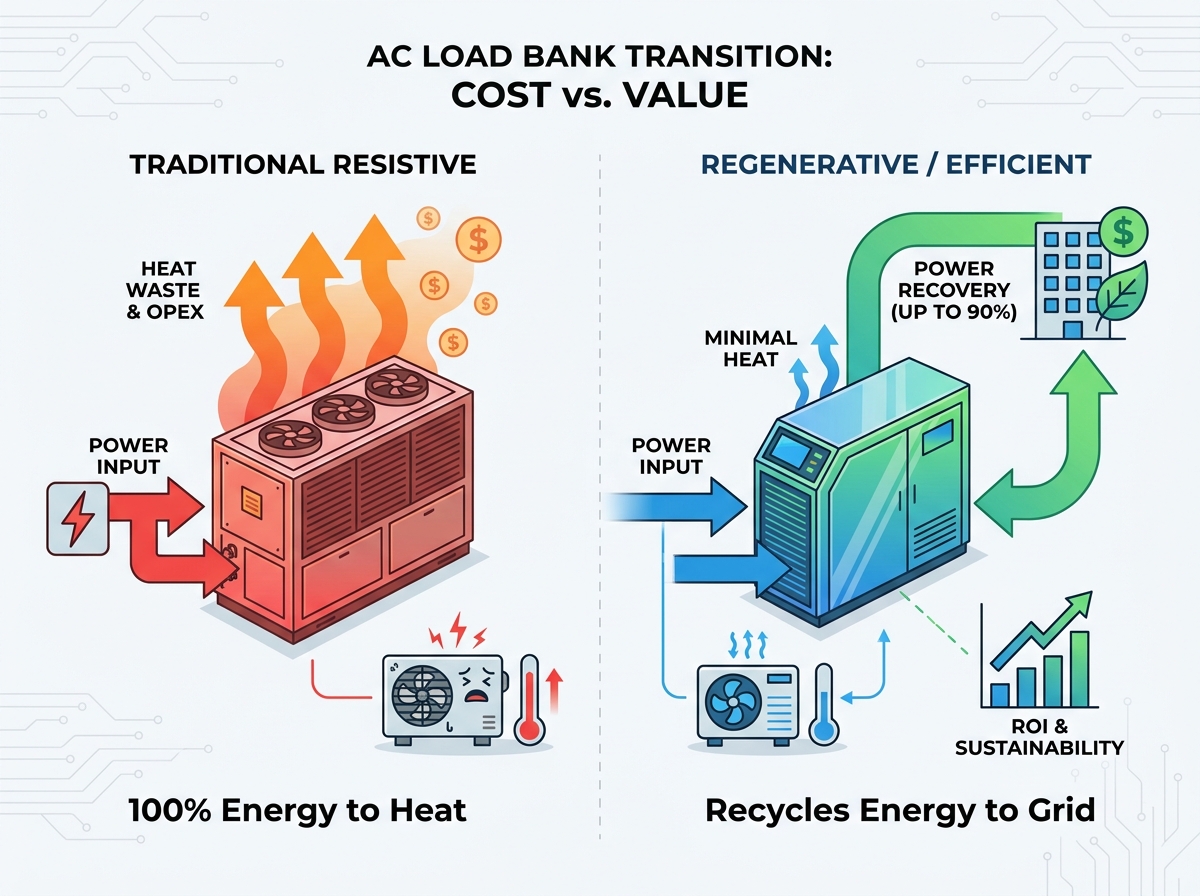
Switching to modern testing equipment requires upfront capital. However, high-frequency testing facilities quickly turn sunk energy costs into recoverable assets. The mathematical foundation for this switch relies on calculating direct power recovery savings.
You can model your baseline savings using a simple formula framework. Calculate your total recovery by multiplying four variables:
Imagine a facility running a 1,000 kW test for 100 hours annually. At $0.15 per kWh, a traditional system burns $15,000. A regenerative unit recovering 90% of that power saves $13,500 directly off the utility bill. This direct recovery shortens the payback period dramatically.
You must also calculate the reduction in secondary HVAC costs. Removing waste heat from a testing environment demands immense cooling power. This becomes particularly vital during closed-loop data center commissioning. Every kilowatt of heat rejected requires corresponding chiller power. Energy recovery eliminates this thermal penalty almost entirely.
Transparent ROI modeling weighs the higher initial hardware costs against projected 5-to-10-year operational savings. We factor in expected maintenance cycles and reduced wear on facility cooling infrastructure. The financial trajectory clearly favors regenerative investments for any continuous testing environment.
| Testing Scenario (1,000 kW) | Annual Test Hours | Traditional Cost ($0.15/kWh) | Regenerative Savings (90% Efficiency) |
|---|---|---|---|
| Annual Compliance Only | 20 | $3,000 | $2,700 |
| Quarterly Maintenance | 100 | $15,000 | $13,500 |
| Manufacturer Burn-in | 1,000 | $150,000 | $135,000 |
Financial gains tell only half the story. The operational improvements often drive the initial purchasing decision. Data centers and healthcare campuses operate under strict environmental tolerances. Introducing sudden, massive heat loads into these spaces disrupts delicate cooling zones.
During data center HVAC commissioning, teams use portable models to simulate active server loads. Traditional resistive units often overwhelm localized cooling zones prematurely. They skew the thermal data. A specialized AC Load Bank engineered for low thermal impact ensures accurate temperature mapping. It proves the cooling design works without setting off thermal alarms.
Advanced thermal management takes two primary forms: liquid cooling and smart air cooling. Each suits different operational realities.
| Technology Type | Primary Benefit | Ideal Deployment Scenario |
|---|---|---|
| Liquid-Cooled Systems | Near-zero heat rejection into ambient air; silent operation. | Confined data halls, cleanrooms, and areas with strict dBA noise limits. |
| Smart Air-Cooled Systems | Variable speed fans reduce parasitic energy waste at partial loads. | Outdoor enclosures, rooftop generator testing, and varied load profiles. |
Precision and load step resolution also separate modern electronic units from legacy iron-core counterparts. Digital controllers offer extremely tight power factor control. They respond to transient load changes in milliseconds. This exactness guarantees your facility meets Uptime Institute standards and local regulatory demands.
Best Practice: Always align your testing schedule with off-peak utility hours. Even when using regenerative equipment, minimizing your peak demand charges yields better financial outcomes.
Upgrading to modern testing infrastructure introduces specific engineering challenges. Facility managers cannot simply plug regenerative equipment into legacy switchgear and expect flawless operation. The physical and electrical realities require careful site assessment.
Grid feedback prerequisites sit at the top of the evaluation list. Regenerative units recycle power. This means they require a facility electrical infrastructure capable of safely receiving bidirectional power. Your switchgear must synchronize frequency, phase, and voltage perfectly. It must comply with strict interconnection standards like IEEE 1547. Failing to verify this infrastructure risks destabilizing local microgrids.
Physical constraints also dictate purchasing decisions. Teams must balance the need for high-capacity testing against the physical footprint of the unit. You face trade-offs between permanent structural installations and portable fleets. Permanent outdoor units save floor space but lack versatility. Portable units easily navigate tight server aisles but max out at lower kilowatt ratings.
Operator training represents another crucial implementation reality. Modern units feature advanced digital controllers. They interface directly with automated testing software. They also feed real-time telemetry into your Building Management Systems (BMS). The learning curve is steep. Maintenance personnel need targeted training to interpret bidirectional power flow data safely.
Common Mistake: Ignoring the reverse power relay settings on facility generators. Pushing recycled power back onto a generator without proper protective relay configuration can trip breakers or severely damage the alternator.
Navigating the complex market of power testing equipment requires a structured approach. Procurement teams should avoid over-engineering their solution. Follow this objective, four-step framework to identify the perfect match for your specific facility needs.
Following these steps ensures you procure an Energy-efficient system. It guarantees alignment with both engineering constraints and corporate sustainability goals.
Modern commercial power testing demands smarter resource management. Upgrading your testing infrastructure transitions mandatory load validation from a pure operational loss into a strategically managed process. You stop burning cash as waste heat. You start treating energy as a recoverable asset.
For facilities conducting rigorous, high-kilowatt load testing, the integration of regenerative systems serves as a mathematically sound investment. The direct utility savings and HVAC burden reductions heavily outweigh the initial capital expenditures over the equipment's lifespan.
We encourage procurement and engineering teams to take the next step. Consult with application engineering experts. Run a customized financial analysis based on your facility's specific load profiles and local utility rates. A transparent calculation will reveal exactly how quickly an advanced testing unit pays for itself.
A: Under optimal conditions, regenerative electronic loads can recover and return up to 85–92% of the tested power back to the local grid. This drastic recovery substantially cuts your net utility draw, turning massive testing expenses into minor operational overhead.
A: Yes. Buyers must carefully verify the IP or NEMA rating. While regenerative models house sensitive digital electronics, reputable manufacturers engineer them with isolated, weatherproof enclosures. These rugged designs withstand harsh industrial deployment, including extreme temperatures and coastal humidity.
A: Liquid cooling primarily solves localized heat rejection and noise issues. It reduces the parasitic electrical load of massive internal cooling fans. However, its main efficiency lies in allowing high-density testing in confined spaces. It prevents your facility HVAC from triggering massive, energy-draining responses.
A: Beyond the purchase price, buyers must account for potential electrical infrastructure upgrades. Your facility switchgear must safely handle bidirectional power flow and synchronize with the grid. Additionally, your maintenance personnel will require specialized training to operate advanced digital controllers safely.


